Cooperative vs Employment: A Fair Alternative, Not a Revolution
Why the cooperative model isn't a utopia but a working alternative to corporate employment. Model comparison, real-world examples, and an honest look at the downsides.
Two Chairs
In November 2024, I was literally sitting on two chairs. During the day — a quarterly planning meeting for the development cluster in a banking project. Budgets, FTEs, roadmap for three quarters. In the evening — a call with future Digital Artel members, designing the profit distribution model. Two worlds, two incentive systems, and me in the middle.
At the daytime meeting, we discussed the bonus program. The team that built the real-time platform, generating a significant share of the division’s profit, would receive an annual bonus of several monthly salaries. Fair? By corporate standards — more than fair. By the standards of value created — well, let’s say the gap is noticeable.
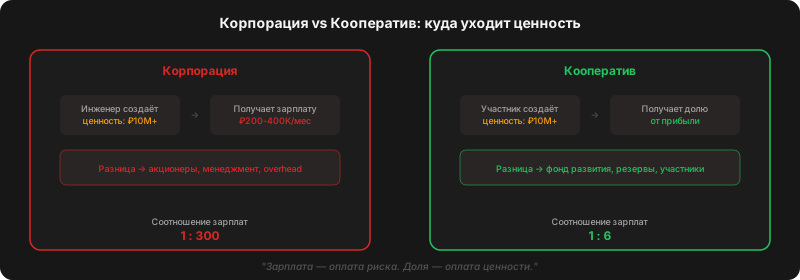
During the evening call, one of the Artel members said something that put it all in perspective: “A salary pays for your risk tolerance. A share pays for your value.” A corporation pays you for agreeing to stability. But if you’re willing to take on some of the risk — why not capture some of the upside?
What’s Wrong with Employment (Without the Emotion)
The problem isn’t evil bosses. The problem is the incentive structure.
An engineer builds a decision engine that processes transactions in real time. The business value of this system is measured in significant sums monthly. The engineer’s compensation — a fixed salary. The corporation takes on the risk: investment, infrastructure, client base. In exchange, it captures the upside. The employee gets stability in exchange for giving up a share of the outcome. This isn’t injustice — it’s structure. But it’s worth asking yourself: does this trade-off work for you?
Second: no voice. You might be the best tech lead in the company. But if a new director decides to “optimize” — your opinion won’t factor in. Not because they don’t respect you. Because the structure is built that way. Decisions are made by management, and the engineer has no systemic mechanism for influence — only personal relationships and political instinct.
Third: stability is a probability. The mass layoffs of recent years have shown that a “stable job” is a statistic that works in your favor until it doesn’t. A strategy shift, a new CEO, “headcount optimization” — and the statistics change. And you don’t control that.
Cooperative: The Mechanics Without the Slogans
A cooperative is an organization where workers are co-owners. Not formally, as in stock option programs, but genuinely: they vote, see the finances, distribute profits. The cooperative model has existed for over a hundred years — Mondragon in Spain with 65,000+ worker-owners, ESOP companies in the US, IT cooperatives like Igalia in Spain. This isn’t utopia — it’s a time-tested alternative.
| Principle | What It Means |
|---|---|
| Co-ownership | Every member owns a share of the results. Not an option with a 4-year cliff, but a real share |
| Transparency | All finances are open. Everyone knows how much the cooperative earned |
| Democracy | Key decisions are made by vote. One member — one vote |
| Distribution by contribution | Compensation is tied to contribution, not title |
| Mutual responsibility | No “I just work here” |
An Honest Comparison
| Criteria | Corporate Employment | Cooperative |
|---|---|---|
| Income | Fixed, predictable | Variable, tied to results |
| Upside | Minimal (bonuses, rarely options) | Direct profit share |
| Stability | High (while the market is good) | Medium (depends on the team) |
| Decision-making | Top-down | Democratic |
| Career growth | Vertical (management track) | Horizontal (expertise + contribution) |
| Bureaucracy | High | Low-medium |
| Entry | Easy (get hired) | Harder (values alignment) |
| Exit | Easy (quit) | Regulated (share buyout) |
| Scaling | Proven | Harder, requires culture |
Neither model wins on all criteria. A cooperative isn’t “better.” It’s about a different set of trade-offs.
Digital Artel: What I’m Building and Why
I’m not leaving the corporate world. Working on a banking project gives me experience managing complex systems and large teams that’s impossible to get elsewhere. But in parallel, I’m building an IT cooperative, because I see that in IT, this model can work particularly well.
Why IT: low capital expenditure (a laptop and internet), measurable contribution (code, design, analysis — all can be evaluated), remote work without being tied to an office, high margins on intellectual work.
The Artel’s first year was about building processes. How to distribute profits? We tried three models before finding one that works.
First — equal shares. Earned it — split equally among everyone. Beautiful, egalitarian, and completely unviable. After two months, it became clear: one person was carrying the project, another was putting in a couple of hours in the evenings, and both were being paid the same. The first started quietly seething. The second genuinely believed everything was fair — after all, they were participating too.
Second — a percentage of revenue from the specific project you work on. Logical, but creates distortions: someone lands a lucrative contract, someone else ends up on a strategically important but low-margin one. People start choosing projects not by interest or value to the cooperative, but by margin. Internal competition — exactly what we were trying to get away from.
Third — and the one that works — a combination: a base portion from total profit (which doubles as a safety net), plus a contribution coefficient reviewed quarterly by the members themselves. Not perfect, but it’s the model where people stopped counting each other’s hours and started thinking about the collective result.
How to make decisions? Voting on every issue kills speed. We proved this ourselves: we once spent two hours voting on which task tracker to use. Two hours of life that nobody’s getting back. We arrived at delegating operations to working groups, voting only on strategy. How to evaluate contribution? That’s the hardest question, and we’re still tuning it.
There were moments when I thought: to hell with it, the traditional model is easier. When two members couldn’t agree on priorities, and instead of a manager’s decision — endless discussion. When variable income in a bad month caused real stress for someone with a mortgage. When a candidate who was perfect on skills didn’t pass the values screen — and you realize you lost a useful specialist for the sake of a culture that barely exists yet.
But there were also moments that are impossible in a corporation. When the team decided on its own to rearchitect a project because everyone felt ownership over quality — not because a manager said so, but because it was their product. When financial transparency killed politics — there’s nothing to negotiate behind closed doors when everything is out in the open.
The Downsides (No Rose-Colored Glasses)
Democracy is slower than autocracy. That’s a fact. When several people vote on every issue, speed suffers. We address this through delegation, but balancing democracy and efficiency is constant work.
Free riders. In a cooperative, it’s harder to part with an underperforming member — they’re a co-owner. You need clear contribution metrics and rotation mechanisms. We wrote this into the charter, but haven’t had to use it yet. Theory and practice may diverge. A specific situation that pushed us to formalize this: one member sat on a task for a month that he’d estimated at “a week max.” He wasn’t sabotaging — just kept switching to his own things, because there’s no external oversight, and everyone’s internal discipline is different. In a corporation, the team lead would notice at the daily standup. In a cooperative where everyone is an equal partner, saying “you’re slacking” isn’t a management decision, it’s a conflict between co-owners. And resolving it is exponentially harder.
Uneven income. No fixed salary — just a share of profits. In a bad month, you earn less. For someone with financial obligations, this is a serious factor. We had a month where a three-week gap opened up between two contracts. For me — unpleasant but manageable, I have a cushion. For a member with a mortgage and a child — real stress. He didn’t leave, but the conversation was tough. Since then, we’ve established a reserve fund — a percentage of every contract goes into smoothing out these dips. A corporation solves this for you — a stable paycheck on the 25th. In a cooperative, you solve it yourself, and that requires financial discipline that not everyone has.
Cultural barrier. In Russia, the word “cooperative” conjures associations with the 1990s. Explaining that this is an international model with a century of history and not a shady outfit — exhausting but necessary. At one meeting, a potential client asked: “A cooperative — is that like a commune? Do you all live in the same house?” Without irony — genuinely asked. In people’s minds, a cooperative is either a Soviet-era shop or hippies on a farm. That it could be a group of professionals with transparent profit sharing and democratic governance doesn’t fit the mental model. Every such conversation is a small piece of awareness-building work. It’s tiring, but without it, the model doesn’t scale beyond a narrow circle of like-minded people.
Scaling is an open question. Mondragon proved that a cooperative can grow to tens of thousands of people. But Mondragon was built over sixty years. We’ve been at it for one. And it’s unclear how to preserve the culture of co-ownership when the number of members goes from five to twenty-five. When not everyone knows each other personally. When a strategy vote becomes a procedure, not a conversation around a table.
Who This Is For
A cooperative might suit you if you’re tired of bureaucracy but don’t want to freelance alone. If you’re ready to be accountable for the collective result. If you value transparency more than a “stable salary.” If you know how to work as an equal.
You’re better off in employment if you value predictability above all else. If you don’t want to think about the business side. If you’re comfortable in a hierarchy.
Both options are perfectly fine. There’s no “right” choice.
But here’s what I’ve noticed after a year of sitting on two chairs: more and more strong engineers are asking the question “why don’t I own the results of my work?” This used to seem like a philosophical question. Now, when one person with AI tools can replace an entire department, it becomes an economic one. And the answer to it will determine how the IT industry is structured ten years from now. I want to be among those who shape that answer, not among those who receive it after the fact.
Based on the Digital Artel manifesto.
— Vladimir Lovtsov
Stay Updated
New articles, talks, and projects — no spam, only substance.
No spam. Unsubscribe anytime.
Related Articles
Cooperative vs Employment: A Fair Alternative, Not a Revolution
Why the cooperative model isn't a utopia but a working alternative to corporate employment. Model comparison, real-world examples, and an honest look at the downsides.
Red Flags in Hiring: A Lead's Perspective
Behavioral patterns in candidates I've learned to recognize over years of hiring. Not an HR checklist, but a team leader's view on building a team that actually works.
Fintech Development: 7 Circles of Hell
An honest guide to what awaits your team when shipping a product to production at a major bank. From hiring to support — each stage is a challenge of its own.